Thursday, 1 September 2011
Melvin Burgess | Kill All Enemies | Author interview
I'm really impressed with Melvin Burgess's book Kill All Enemies.
The YA author did extensive research speaking to teens and staff involved in PRUs, pupil referral units before writing the novel. It's a portrait of Britain's underclass, to a degree, a timely reminder post Riot Britain that teenagers behaving badly is not a black and white issue, a simple issue, but often very complex.
I've just interviewed Melvin and will post an extract in due course.


Tuesday, 30 August 2011
Neil Gaiman | JK Rowling didn't rip me off, we stole from the same people
 |
| Forgotten? |
During his talk on Saturday Neil Gaiman made a reference to a graphic novel of his I'd never heard of: The Books of Magic.
He made a joke about it. "People said JK Rowling stole off me. Of course she didn't. We were just stealing off the same people."
Or words to that effect.
The cover of the book is striking. What the heck is Harry Potter doing on a flying skateboard, and why is Hedwig grey?
The superficial overlap with Harry and Hogwarts is extraordinary. And I wondered how on earth I didn't already know that Gaiman, hardly an unknown writer, indeed, probably the best known fantasy writer in the UK right now, had written such a book, albeit as long ago as 1993.
Gaiman solved the mystery himself, to a degree. He explained that The Books of Magic were published by DC comics who sold the adaptation rights to Warners Bros, who in turn produced a brilliant first draft of the script. But it was just about this time that Harry Potter took off.
And remember, Harry Potter wasn't just another successful kids book: it was a phenomenon. Children, adults, dogs were queueing round blocks to get copies, to hear Rowling speak. Shops went mad about Harry Potter with supermarkets often giving hardbacks away for as little as £3.99, just so they could have a piece of the Harry action. And of course Warners won an extremely competitive bidding process to make the blockbusting movies.
Which have made a billion or so since.
Gaiman's graphic novel, in a parallel universe, might have had us all talking and dreaming about magic. As it was it was swamped by Rowling's juggernaut. Fair play her.
As for the film adaptation: Warners wanted to make the film, but it needed to be different to Harry Potter. So they messed about with the script so much that DC and Gaiman said, no thanks, please don't make this now. As for the book, it has been in limbo. But with Harry's adventures now finished, surely, surely it's time for a revival.
Monday, 29 August 2011
Skellig author David Almond | The True Tale of the Monster Billy Dean | Q&A

David Almond is a highly regarded author for children. He's won a Hans Christian Andersen medal, a Carnegie, the plaudits of the critics and he has seen his first novel, Skellig, turned into a play, an opera and a film - the latter starring Tim Roth in a production by Sky.
His new book is pitched at an older market. It read to me more like an adult novel than a child's. But it will appeal to YAs too.
What follows is a portion of an interview I had with him. You can read more in The Big Issue (on sale on the streets of Britain this week).
 |
| David Almond |
Billy speaks in a very particular way. The accent is from your own home area?
Yes it is. More and more in my work have been using a northern language. One of the liberations I’ve felt over the last few years is that I have felt able to use this voice and language of this area – and to kind of explore and celebrate its fundamental beauty. Even though Billy’s language is fractured and quite dark it came to me in a poetic way.
How did you decide how the words were written down?
I didn’t do a plan, it felt instinctive at first. Then I realised it needed to be more orderly. In the final version once his spelling improves it is because he has learned words in the world. When his dad leaves him a letter, his words improve. They are spelled properly after the letter. In the butcher’s shop he learns how to spell the words in the signs. But at first it was a way of getting his thoughts into paper.
Billy has been raised in isolation – in a prison effectively. Were you inspired by the likes of Natascha Kampusch, the Austrian girl who was kidnapped and held?
I wasn’t thinking of that one. It is based more on earlier stories. There is a film by Herzog The Enigma of Kaspar Hauser [1974], about a boy kept in darkness for the first twenty years of his life. It had an enormous shattering affect on me and I think since then I’ve been trying to write that movie. It is [also] very influenced by a French boy , the Wild Boy of Aveyron, a true story of a boy who grew up in the woods and was brought out into civilisation and they tried to civilise him. So it drew on those stories, people from the past who were brought up in darkness. There were always stories about wolf children and kids who grew up with monkeys so it is using that idea but in what begins as a very ordinary northern town. You think what will happen if these things happen here?
There is a dystopian aspect to the novel. We get the sense that something terrible has happened, can you explain?
Yes, that came about because I wanted this boy who had been kept away. It needed to be a story about learning how to become a boy, becoming civilised, learning how to write, and there are examples of that sort of thing - a case in Los Angeles where a girl was kept in a shed at the back of the house. But they tend to be quite dark tales of abuse. And I didn’t want to write that kind of story. I didn’t want him to be abused. I wanted him to be kept in darkness and to save himself. So I thought he has to be born at a time of great drama, of great doom. There was a sense to his being kept away. But also he was the one true good heart in the midst of all this destruction. A time of great terror. It is seen as a great time of hope that as all this is going on he is being born.
I got the sense that the people in the book had been thrown back to a pre-modern time, there was something quite medieval about them.
The father, the priest, has this kind of medieval vision of himself and it probably comes from my own catholic upbringing. It wasn’t a deliberate attempt to seem medieval but as I wrote the story it felt medieval to me. As Billy writes on the mouseksin using the feather of the bird it’s like he is going back to Anglo-Saxon times, like he is the microcosm of Christianity. I wasn’t doing that deliberately but that is kind of what seemed to be growing to me. He senses that his story is the story of civilisation.
Sunday, 28 August 2011
Neil Gaiman | Edinburgh 'fringe' event | Sequel promised to American Gods


 |
| A pre talk cup of tea, our new copy of American Gods, Neil in full flow... |
As it celebrates its tenth anniversary, Neil Gaiman admitted last night that he is working on a sequel to his cult hit, American Gods.
He said that the story was coming together and that he was likely to start writing it soon.
Gaiman, author of American Gods, Coraline, The Sandman series, Stardust and countless other novels was speaking at a 'fringe' appearance in Edinburgh. He'd already been at the official Edinburgh International Book Festival: but this was an extra gig organised by the Edinburgh Book Shop. There's a nice blog about the event here, from one of the people involved.
About a hundred Gaiman fans - and many of them really were fans, who came toting huge anniversary boxed set editions of The Sandman - gathered in The Crypt, below St John's Church on the corner of Princes Street and Lothian Road. This would have been a great choice of venue even if it wasn't a vegetarian cafe (Neil is a famous veggie). Food was served during an interval: almost all of which was gloriously edible. If this is a precedent for book events then it is a good one.
Gaiman was charming. He started with a glorious short story from Smoke and Mirrors, the opening tale about a pensioner finding the Holy Grail in her local Oxfam shop (and buying it for 40 pence). It's a lovely, slow burning tale: funny and poignant. Classic Gaiman.
The chit chat ranged the expected areas. We heard about his bees freezing to death in the Minnesota winter. We heard about Dr Who - don't hold your breath for a second Gaiman episode, the one he did seemed to dominate 18 months and I doubt the BBC could afford to pay him for a second one. Incidentally - and this is BIZARRE - he suggested to the BBC that he write a novelisation of the episode based on material that didn't make the final cut. And the BBC said NO! Unbelievable. Apparently it jarred with their current novelisation policy ( I ask you?) Memo to the Beeb, this was Neil Gaiman: the answer is yes.
Gaiman's wide ranging interst - horror, graphic novels, scie fi, myth - were obvious. They are the root of what is becoming a very broad appeal. Sure, there are the comic fanboys in the audience (few men wore a shirt with a collar, I noticed: it was Dr Who T-shirt central). But he also appeals to children and to people like me, who simply love a well told story.
Looking forward to American Gods II, Neil. But don't be too quick, I haven't actually read the first one yet.
Friday, 26 August 2011
Top 100 Books | The sense of a list
 |
| My old Unwin Books paperback copy of The Hobbit. The drawing is by JRR Tolkein |
Why make a list of your favourite books?
Think of it as a snapshot. In part it sums up who you are, what you like reading, what you have read.
In another sense it highlights what you might be missing out on. If your personal Top Ten are all sci-fi, or thrillers, maybe you should stretch yourself a bit and read out of those genres?
Similarly, if your list reads like an English Lit syllabus ask yourself the question: have you moved on since University?
Personally I would say that your Top 10 in 2011 should be completely different to your Top 10 from 2001, say, or 1991. as we grow older, our tastes change and our reading experience widens.
That said, there will be titles on every person's list which will have been with them since childhood. Reading is like that: a book is such a personal experience it can stay with you far longer than a film or a play can. It's like the narrative is hardwired into your brain. I heard a line the other day fromm The Hobbit - the audio book started playing unexpectedly in the car. The amazing thing is although I'd not read that book in years, I knew the line, could almost see it on the page.
What makes a book one of your best loved, though?
When I first mooted the idea of a list, I asked for the books you would recommend people read which didn't necessarily seem obvious. I wanted to uncover some hidden gems.
I still think the 'best loved' moniker can help do this.
When you send in your lists to Top100books@bigissue.com list the books you care about the most, not the ones that you feel will make you sound the smartest.
That way, the finished list will be an honest snapshot of what Britain is reading. And that will be a fascinating read in itself.
Tuesday, 23 August 2011
Edinburgh International Book Festival | Guardian Debate | NOT The End of Books
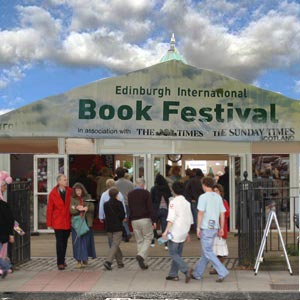
The Guardian sponsored debate The End of Books at the Edinburgh International Book Festival on Saturday was entertaining enough - but it missed the point.
Ewan Morrison's talk in favour of the motion – the end is nigh, etc, reproduced on guardian.com at the moment - was considered and laden with stats. But I still think his take on the issue is wrong. The other speakers concentrated on the novelty of producing an iPad app of The Waste Land and the love of holding a paperback in your hands. Both these things seem as transient as the other to me.
Ewan Morrison's talk in favour of the motion – the end is nigh, etc, reproduced on guardian.com at the moment - was considered and laden with stats. But I still think his take on the issue is wrong. The other speakers concentrated on the novelty of producing an iPad app of The Waste Land and the love of holding a paperback in your hands. Both these things seem as transient as the other to me.
Digital or paper, there will always be a demand for new authors, new voices, because each generation needs to recreate the world in its own image. I wonder how many kids now will read (and watch ) A Game of Thrones instead of Lord of the Rings. How many Harry Potter fanatics have ever read The Famous Five? Ewan seemed to suggest that publishers and Amazon -- the digital publishing giant of the near future [ie evil empire] -- will simply reproduce and mash up old writing and sell it anew. New writers will soon be on the scrap heap forced to take jobs in call centres rather than follow their calling by producing potential Booker Prize winners.
Ewan even referred to Shakespeare and Dickens as if they were getting by on modest advances awarded to them simply because their work was considered (by who? The great and the good?) to be artistically worthwhile. In reality, Wills and Charles were two of the most commercially successful writers of all time. Neither would recognise the current economic realities of the publishing / literary world, but they'd want to get paid.
The attraction of digital is that it allows a writer to bypass the traditional publishing log jam. Self publishing is no longer the resort of the vain but a decent option for a new talent wanting to showcase him or herself. A few have even made good money out of self Kindle publishing -- Amanda Hocking etc. But can the trick these genre writers have pulled off be repeated in the literary fiction world?
The fact is: lit-fic simply isn’t as popular as other genres and it is hard to feel sorry for well educated, talented author wannabes who would rather spend their days in a garret writing prose no one wants to read instead of holding down a proper job. Dedicate your life to literature if you want, but do it at your own expense.
Monday, 22 August 2011
Top 100 Books | Big Issue relaunches the list

Are these Britain’s most loved books?
Lord of the Rings, JRR Tolkein
To Kill A Mockingbird, Harper Lee
Tess Of The D’Urbervilles, Thomas Hardy
Lanark, Alasdair Gray
Midnight’s Children, Salman Rushdie
His Dark Materials, Philip Pullman
Jonathan Strange and Mr Norrell, Susanna Clarke
Pride and Prejudice, Jane Austen
Gormenghast, Mervyn Peake
The Road, Cormac McCarthy
With over a million paperback sales in Britain alone, David Nicholls’ bittersweet romance One Day is one of the best-loved books of the moment. The film is out this week - which is why the book is appearing on the covers of magazines.
But what are the best-loved books of all?
The Big Issue is this week relaunching my off the cuff bid to compile a Top 100: the books you couldn’t live without.
I’ve been running the poll for the past few weeks right here. But now the magazine sold by the homeless is taking the idea to a national audience via its own websites www.bigissuescotland.com and www.bigissue.com.
Together, we want you to list the ten books you think are the best you've ever read. The ones you believe are genuinely memorable and entertaining.
The responses I’ve received so far have been extraordinary: diverse, unusual and challenging.
But even with a small sample it was clear that a few titles were appearing again and again.
From these I have compiled a Top Ten – reproduced here. And it’s hardly a surprise that perennial favourites Lord of the Rings and To Kill A Mockingbird are neck and neck at the top.
But notice that there is no Dickens, JK Rowling or Agatha Christie – despite the fact they are the biggest selling authors of all time.
Instead, readers went for cultish books like Lanark, Gormenghast and the bleak American masterpiece The Road.
What makes the final list depends on you.
Email your top ten to top100books@bigissue.com.
There are no boundaries. All genres should be considered - just vote for the books that mean the most.www.bigissuescotland.com
Everyone who has voted so far will have their lists folded in to the new campaign. Over the next few days I'll break down the list of titles I have so far to give you some ideas, and to create talking points.
What has become obvious is that the more people who take part in this poll, the more meaningful the final list will be so please share this link with your friends on social media and encourage others to take part. We are all really looking forward to seeing what the final top 100 will look like.
Subscribe to:
Posts (Atom)