Showing posts with label amazon. Show all posts

Monday, 21 May 2012

Waterstones sign Kindle deal with Amazon | e-books on the High Street

James Daunt, the MD of Waterstones, has announced a deal to sell the Kindle through the chain of bookshops.

Waterstones is the only big player left in books on the British High Street. The immediate reaction has been one of shock and disbelief. Many seem to think that the arrangement is great for Amazon, terrible for Waterstones.

James Daunt, Managing Director of Waterstones, said: "At Waterstones, we are committed to improving our bookshops quite radically to offer the best possible book buying experience. It is a truly exciting prospect to harness also the respective strengths of Waterstones and Amazon to provide a dramatically better digital reading experience for our customers.
"The best digital readers, the Kindle family, will be married to the singular pleasures of browsing a curated bookshop. With the combination of our talents we can offer the exceptional customer proposition to which we both aspire."

Jeff Bezos, Amazon.com Founder and CEO, said: "Waterstones is the premier high street bookseller and is passionate about books and readers - a dedication that we share deeply. We could never hope for a better partner to bring together digital reading and the physical bookstore."

The pessimistic take is that Daunt appears to be inviting book buyers to browse his bookshops, then buy what they like the look of on their Kindle. This may well be why the chain is investing heavily in coffee shops. People will want to buy a coffee while they are at Waterstones. They may not be buying books.

The really surprising thing about the deal is that Daunt has made it clear in the past that he isn't an Amazon fan. The Telegraph reported comments in December in which he likened the Internet behemoth to Old Nick himself.

Most of Twitter seems to have decided that this is a terrible one. But perhaps it is inevitable. Most ardent readers will embrace the Kindle in the same ways as people embraced paperbacks: as an inexpensive, convenient medium to read books. The challenge for the likes of Waterstones but perhaps even more so for the publishers, is to stay relevant in this new arena.

Tuesday, 23 August 2011

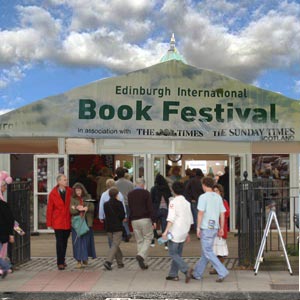
Edinburgh International Book Festival | Guardian Debate | NOT The End of Books


The Guardian sponsored debate The End of Books at the Edinburgh International Book Festival on Saturday was entertaining enough - but it missed the point.

Ewan Morrison's talk in favour of the motion – the end is nigh, etc, reproduced on guardian.com at the moment - was considered and laden with stats. But I still think his take on the issue is wrong. The other speakers concentrated on the novelty of producing an iPad app of The Waste Land and the love of holding a paperback in your hands. Both these things seem as transient as the other to me.

Digital or paper, there will always be a demand for new authors, new voices, because each generation needs to recreate the world in its own image. I wonder how many kids now will read (and watch ) A Game of Thrones instead of Lord of the Rings. How many Harry Potter fanatics have ever read The Famous Five? Ewan seemed to suggest that publishers and Amazon -- the digital publishing giant of the near future [ie evil empire] -- will simply reproduce and mash up old writing and sell it anew. New writers will soon be on the scrap heap forced to take jobs in call centres rather than follow their calling by producing potential Booker Prize winners.

Ewan even referred to Shakespeare and Dickens as if they were getting by on modest advances awarded to them simply because their work was considered (by who? The great and the good?) to be artistically worthwhile. In reality, Wills and Charles were two of the most commercially successful writers of all time. Neither would recognise the current economic realities of the publishing / literary world, but they'd want to get paid.

The attraction of digital is that it allows a writer to bypass the traditional publishing log jam. Self publishing is no longer the resort of the vain but a decent option for a new talent wanting to showcase him or herself. A few have even made good money out of self Kindle publishing -- Amanda Hocking etc. But can the trick these genre writers have pulled off be repeated in the literary fiction world?

The fact is: lit-fic simply isn’t as popular as other genres and it is hard to feel sorry for well educated, talented author wannabes who would rather spend their days in a garret writing prose no one wants to read instead of holding down a proper job. Dedicate your life to literature if you want, but do it at your own expense.

Tuesday, 31 May 2011

Would you pay for a book that Pat Kane and Terry Jones haven't written yet?


A couple of weeks or so ago I noticed a strange post on Pat Kane's Facebook page. Kane is a musician, writer, journalist, consultant and activist. Despite being utterly in the thrall of the SNP he's often worth listening to on media matters, which is why I befriended him on FB.
But the post in question really made me wonder.
Just to fill you in, Kane had a successful recording career with his band Hue and Cry. He's often in the public eye as a media and cultural critic and still plays live. He happens to live not so far away from me in Glasgow's West End and he is very interested and involved in social media.
Which is all fine and interesting. And my point, I guess, is that he's not starving in a garret somewhere.
Pat's latest project, some might say wheeze - and he 'launched' it in the traditional old fashioned papery Guardian - was to announce that he intends to write a book, Radical Animal, which would have an online social network element, and that he was looking for $10,000 (or £6K approx) to give him the time to write the MS.
Instead of getting a publisher to pay him an advance, he is offering the general public the chance to stump up for him instead. So if you are interested in reading Pat's as yet unwritten book, you could sponsor him to write it.
How many people out there, I asked myself, are so eager to hear Pat Kane's thoughts on a subject, any subject: eager enough to pay in advance for a man who tweets and appears regularly on traditional media outlets effectively for free?
Then the other day I saw a Tweet with a link to unbound.co.uk. This is another example of the net being used to democratise the book production process. This from their website: "What's different is that instead of waiting for them to publish their work, Unbound allows you to listen to their ideas for what they'd like to write before they even start. If you like their idea, you can pledge to support it. If we hit the target number of supporters, the author can go ahead and start writing..."
So Kane's pay up front idea is wider than just him (and I am sure there are other examples probably in the US: links welcome).
There is clearly something attractive about democratising publishing. Its appealing to think that we'll get the books we want if we remove these elitist publishers with their mad ideas about thrillers selling hundreds of thousands of copies and no one being interested in the poignant memoir of a 26-year-old former drama student who once did drugs at a party.
I don't think it's true, of course. Publishers bring more to the party than just a fancy cover and shelf space in Tesco, as important as those two elements are. But I can see why some people might get excited over the idea.
What puzzles me is how anyone thinks this pay-up-front model is at all viable. We live in a book economy in which publishers struggle to sell new paperbacks at half price through the megaonline marketplace of Amazon. Waterstones has just been sold to a Russian billionaire. Borders is gone. One key factor in their demise is over supply: too many books, depressed prices, consumers who want to spend less and less.
Then there is self-publishing. You can put your MS straight out into the marketplace on Kindle etc without a publisher getting involved. You reap the rewards yourself. But you don't get paid up front and the per unit price is necessarily low.
My question is: just who thinks there are enough readers out there with enough time and money to speculate on books - fiction, non fiction - which haven't been written yet?
A glance at the Unbound website tells me that each of their current offerings has a long way to go before they get funded. In fact, the best of them - a short story collection by Python legend Terry Jones - is 98 per cent short of its target, albeit with 48 days to go.
I wish Pat Kane good luck, I'll sit and watch the result with interest. Similarly with Unbound. But I don't see either of these schemes coming off. Not in any meaningful, sustainable way.
What do you think?

Thursday, 21 April 2011

Amazon's Kindle store in Germany dominated by English language books


Globalisation has been with us for quite some time. A few hundred years. Similarly, English won the war to become the lingua franca some time ago. It's undoubtedly the default setting for global business and while there are exceptions - and the rise of China might well alter things eventually - its status as number one looks safe.

Even so, this report in the Bookseller's Futurebook blog really surprised me. When it comes to books, Europe has a rich culture, and people read books in the vernacular. Whether a novel is a romance, a thriller or considered literary, it is closely related to the spoken word. Just as I think and dream in English I find it hard to imagine ever reading a novel in another language.

But then I am particularly inept when it comes to languages. I have a few words of German and French but not enough to hold a conversation in either language. In this respect I think I am probably like most Brits and perhaps most Americans too. English is it: why bother with anything else?

In Europe, because of the dominance of English, people don't think the same way about their own language. The French love French. The Germans love German. But they speak English too, in large numbers. We were recently in Spain and were impressed by just how many locals were able to speak a little English - enough to do business in anyway.

According to Futurebook however, this trend toward English may well end up with books written in German being squeezed out as reading in English becomes the norm.

What an extraordinary idea. An entire language, one as old and as venerable as German, seeing its literary traditions dying out due to the economic power of Amazon and its pesky Kindle machine?

But why not? Technology is bringing the world together, fast. If everyone is on Facebook, why should we be speaking different languages? Wouldn't that get in the way of poking and messaging each other? In Ridley Scott's futuristic Blade Runner (pictured above), Harrison Ford's character speaks a hybrid language of English, Japanese and Chinese.

Of course, English is in pole position at the moment. But with the rise of China and its billions of people, who could say that the future language of the world might not be an English-Mandarin mix? Language is so fluid, and the world so increasingly small, it would be remarkable if this didn't happen.